
Table of Contents
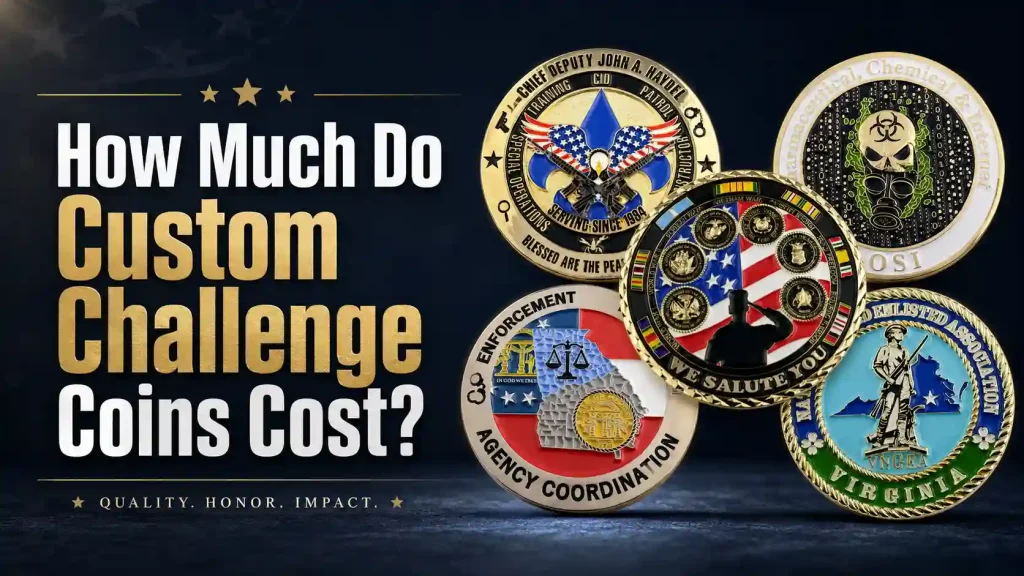
Many customers ask us, “How much would it cost to turn my design into a custom coin?”
As a general rule, an order of 100 coins starts at around $300 in total. However, the actual price will depend on the coin size, order quantity, design complexity, and production options you choose.
Below, we’ll break down the costs in more detail.
How Much Do Custom Challenge Coins Cost on Average?
There is no single average price that applies to every order. As a practical reference, an order of 100 custom 1.75-inch challenge coins costs about $3.63 per coin based on VeperPins’ current pricing.
You may find prices online ranging from $1 to $15 per coin. That does not necessarily mean one supplier is cheap and another is expensive. Those prices are often based on completely different quantities, sizes, and design requirements.
A Simple Company Logo
A standard-size coin with a flat logo, common plating, and a few enamel colors is usually more affordable, especially at higher quantities.
A High-Relief Unit Design
A unit coin with deep 3D relief, multiple levels, special finishes, custom edges, or premium packaging takes more work and will cost more.
Price Per Coin and Total Project Cost Are Not the Same
The price per coin usually refers to the cost of producing each piece. Your total project cost may also include the mold fee, 3D work, special edges, upgraded packaging, or other optional features.
That is why two orders with the same quantity can still have very different final totals.
What Factors Affect the Cost?
Order Quantity
Order quantity is one of the biggest factors behind the final price. Smaller runs cost more per piece because every project includes fixed setup costs, especially the mold.
For example, the mold fee for a 1.75-inch design is $125. That cost applies whether you order one piece or one hundred because the same tooling is required before production can begin.
As the quantity increases, that fixed cost is spread across more pieces. At VeperPins, the mold fee is waived on orders of 300 pieces or more, bringing the effective cost per piece down even further.
- Base price
- $3.91 × 100
- Product subtotal
- $391
- Mold fee
- $125
- Total project cost
- $516
- Base price
- $3.46 × 500
- Product subtotal
- $1,730
- Mold fee
- Waived
- Total project cost
- $1,730
Coin Size and Thickness
Size affects both the appearance of a coin and the amount of metal needed to produce it.
Uses less metal and is usually more affordable, especially for larger orders or simpler designs.
A common choice that balances price, design detail and overall presentation.
Provides a stronger visual presence and more space for text, logos and detailed elements.
Often chosen for commemorative pieces, presentations and more complex artwork.
In general, larger and thicker coins require more metal. They may also increase mold, production, packaging and shipping costs.
See our challenge coin size guide2D vs. 3D Design
A 2D design is usually more affordable than a high-relief 3D design. Standard 2D artwork uses clearly separated flat levels, while 3D artwork uses rounded curves, gradual height changes and sculpted details.
Works well for logos, text, borders and artwork with clearly defined raised and recessed areas. The mold is simpler to produce, so the cost is usually lower.
Creates rounded faces, figures, vehicles, buildings and other realistic shapes. The additional 3D charge starts at $125, depending on coin size and artwork complexity.
Smooth curves and gradual height changes take longer to engrave than simple flat levels.
High-relief artwork may require additional thickness to keep raised and recessed details clear.
Sculpted surfaces can require more production time, hand finishing and quality inspection.
Finishes, Color, and Plating
No added color, with a traditional and formal appearance. It is usually the most affordable option.
Adds bright color and a textured surface. It costs more than an uncolored design but works well for most units and events.
Grinding and polishing create a smooth surface. The additional production work usually makes it the most expensive of the three.
Adding color to both sides usually costs about $0.23 more per coin because the second side requires another round of enamel filling, drying and inspection.
Polished gold and polished silver are standard options included at no extra charge. Antique finishes generally add about $0.65 per coin. Dual plating costs around $0.70 per coin because two metal finishes must be applied to separate areas.
Edges and Packaging
Edge details and packaging choices can also affect the final project price.
Flat edges, raised rope borders and custom-shaped outlines are normally available at no extra charge.
Rope-cut, diamond-cut, spur and reeded edges require additional tooling or machining.
Most orders include an individual clear PVC pouch at no additional cost.
Plastic coin cases and velour pouches are available for an additional charge depending on their size and style.
Real Custom Challenge Coin Cost Examples
Below are three real customer orders. Each coin is 1.75 inches and uses comparable production options, but the order quantities are different. You can see how quantity affects the price per coin and the total project cost.
50 Coins
- 1.75-inch size
- Soft enamel
- Color on one side
- Standard plating
- Standard edge

100 Coins
- 1.75-inch size
- Soft enamel
- Color on both sides
- Standard plating
- Standard edge

300 Coins
- 1.75-inch size
- Hard enamel
- Color on both sides
- Standard plating
- Mold fee waived

How to Reduce Challenge Coin Costs
Keeping costs under control does not mean stripping away everything that makes the coin look good. The goal is to spend more on the details that matter and avoid paying for features that add little to the finished design.
-
01
Compare 50 Pieces with 100
When the budget allows, increasing the order from 50 to 100 pieces can lower the effective cost per coin because the mold and other setup costs are spread across more pieces.
-
02
Choose a Standard Size
A 1.75- or 2-inch coin usually provides a good balance of price, visibility, and room for artwork.
-
03
Use 3D Where It Matters Most
Save high-relief 3D work for a face, emblem, vehicle, or other main feature. Less important areas can remain in standard 2D.
-
04
Keep the Reverse Simple
If the back does not need detailed artwork, raised or recessed metal text can look clean and professional without adding full color to both sides.
-
05
Stick with a Standard Edge
Decorative edge cuts can look great, but they are not necessary for every project. Use paid upgrades only when they noticeably improve the overall design.
-
06
Take Advantage of Free Mold Pricing
At VeperPins, the mold fee is waived on orders of 300 pieces or more, making larger runs more cost-effective.
-
07
Confirm the Full Quantity Up Front
Ordering the amount you are likely to need from the start is usually cheaper than placing several small follow-up orders. Reorders of the same design can also reuse the existing mold.
-
08
Share Your Budget Early
Tell your sales representative what you want to spend before the artwork is finalized. They can suggest a practical combination of size, finish, color, and production options.
-
09
Do Not Cram Too Much into a Small Coin
Choosing a smaller size may save a little money, but squeezing in too much text and detail can make the final piece difficult to read.
-
10
Order Early
Leave enough time for artwork, production, and shipping so you do not have to pay rush fees to meet a tight deadline.
Get an Exact Price for Your Custom Challenge Coins
Online pricing guides can give you a general idea of your budget, but the final cost will depend on your artwork, coin size, order quantity, and finish. Send us your completed design—or even just a rough idea—and we’ll recommend the most cost-effective way to bring it to life.
Start creating your custom challenge coins today!
Frequently Asked Questions
Is the mold fee charged on every order?
No. The mold fee is usually charged only on the first order. If you reorder the same design while the mold is still on file, you will not need to pay it again. VeperPins keeps molds for two years.
Are 3D challenge coins more expensive?
Yes. A 3D design requires more detailed mold engraving and additional production setup, so it usually costs more than a standard 2D design.
Does adding more colors increase the price?
Standard enamel colors do not normally increase the price by themselves. The cost may increase if you add color to both sides or use special options such as gradients, UV printing, or glow effects.
Is shipping included in the challenge coin price?
Standard shipping is included for U.S. orders. For Canadian orders, shipping is confirmed in the quote based on the destination and order size.
What is the most cost-effective challenge coin size?
A 1.75-inch or 2-inch coin usually offers the best balance of price, detail, and readability. A 1.75-inch coin costs less, while a 2-inch coin gives complex artwork and text more room.


