Table of Contents
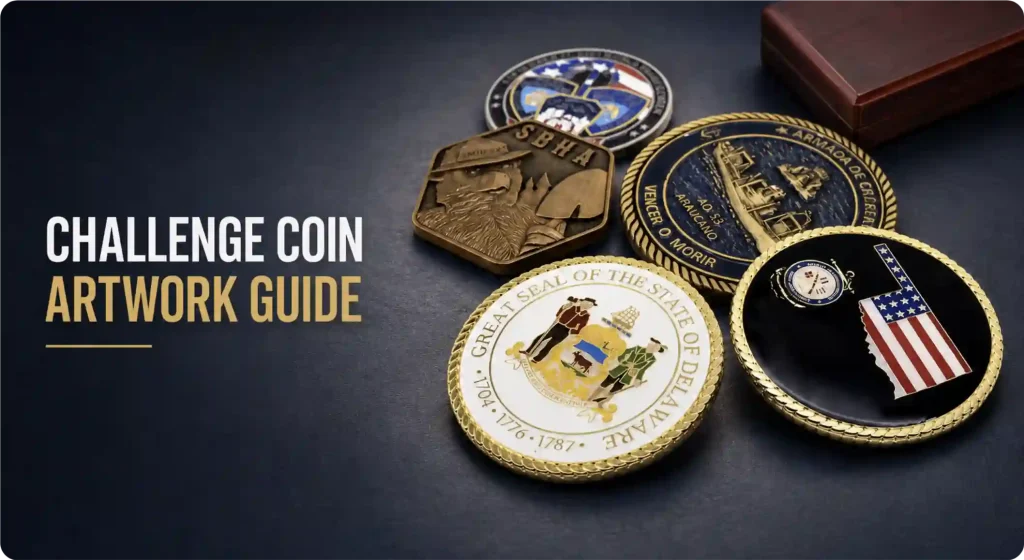
When you submit artwork for a custom challenge coin, the final production design may look slightly different from your original image.
Small text, thin lines, narrow color areas, and complex details may need to be adjusted to ensure they can be reproduced clearly during the manufacturing process.
This guide explains the key artwork requirements, common production limitations, and important details to review before approving your final proof.
What Artwork Can You Submit?
You can start with a finished design or just a few basic references. We can work with:
- Vector files AI, EPS, SVG, or editable PDF
- Image files Clear PNG or JPG images
- Logos and badges Company logos, unit emblems, or department badges
- Hand-drawn sketches A simple sketch with notes about the layout, colors, and wording
- Existing coin photos Clear front and back photos are most helpful
- Written instructions An idea, required wording, and a description of the intended use
You do not need a finished professional design before contacting VeperPins. Tell us what the coin is for, which words and elements must be included, and share any references you have. Our team can help develop the rest.
Which File Formats Work Best?
We can work from vector files, clear images, or a hand-drawn sketch. The better the source file, the less redrawing is usually needed before we prepare your production proof.
| File Type | Recommendation | What to Know |
|---|---|---|
| AI, EPS, or SVG | Best Option | Vector files stay sharp at any size and make it easier to adjust text, lines, shapes, and colors. |
| Editable PDF | Recommended | Works well when the text and graphics remain editable rather than being saved as one flat image. |
| High-Resolution PNG | Accepted | A clear PNG is suitable as a reference, although fine details may need to be redrawn. |
| JPG or Screenshot | Accepted | Send the clearest original image available. Small, blurry, or compressed files may need to be recreated. |
| Hand-Drawn Sketch | Accepted | Include the wording, preferred colors, coin size, and any important layout instructions. |
Not sure whether your file is ready for production? As an experienced custom challenge coin supplier , VeperPins can review your artwork and recommend any necessary adjustments before the production proof is prepared.
For the best results: Send the original file whenever possible. Images downloaded from social media or saved from messaging apps are often compressed, making small text and fine lines harder to reproduce accurately.
Minimum Text, Line, and Color Area Requirements
These specifications are general production guidelines. Exact limits may vary depending on the coin size, plating, artwork complexity, and manufacturing process.
| Artwork Element | Typical Minimum | Recommended Standard |
|---|---|---|
| Raised Metal Text | 1.0–1.5 mm | 2.0 mm or larger |
| Recessed or Color-Filled Text | 1.2 mm | 1.5–2.0 mm or larger |
| Text Stroke Width | 0.3 mm | 0.5 mm or wider |
| Metal Divider Line | 0.3 mm | 0.5 mm or wider |
| Enamel or Color Area Width | 0.8–1.0 mm | 1.5 mm or wider |
| Distance from Artwork to Outer Edge | 1.5 mm | 2.0 mm or more |
Small text may become difficult to read, especially on smaller coins or designs with heavy detailing.
Very small color areas may be difficult to fill evenly and may require slight design adjustments.
Separate enamel colors typically require clear metal divider lines to maintain clean boundaries.
How Should Pantone Colors Be Submitted?
The most reliable way to specify enamel colors is to provide Pantone color numbers. We use the Pantone Matching System as a production reference and aim to match the selected shade as closely as possible.
If Pantone numbers are not available, you can send RGB, CMYK, or HEX values. These digital values help us understand the intended color, but they cannot be used directly as an enamel mixing formula.
Provide the exact Pantone number whenever brand color accuracy is important.
These values can guide color selection but still need to be matched to a suitable Pantone shade.
Screen colors and descriptions such as “dark green” or “light pink” are too general for final color approval.
Colors can look different from one screen to another. Lighting, metal plating, and the surrounding finish can also affect how the enamel appears on the finished coin. For this reason, screenshots should not be used as the final color standard.
Use the same Pantone number wherever the same color appears. For example, do not label one red area as Pantone 185 C and another as Pantone 186 C unless you intentionally want two different shades.
What Should You Check Before Approving the Proof?
Before approving the final production artwork, review each detail carefully:
- Coin size and thickness
- Front and back orientation
- Names, dates, numbers, and spelling
- Pantone color numbers
- Plating finish
- Raised and recessed areas
- Edge text
- Numbering placement
- Cutouts and other special structures
Pay particular attention to names, dates, unit information, badge details, and numbers. These details may be difficult or costly to change once the mold or production process has started.
Not sure how your original design will be adapted for production? Read our guide to matching challenge coin artwork with the right production process .
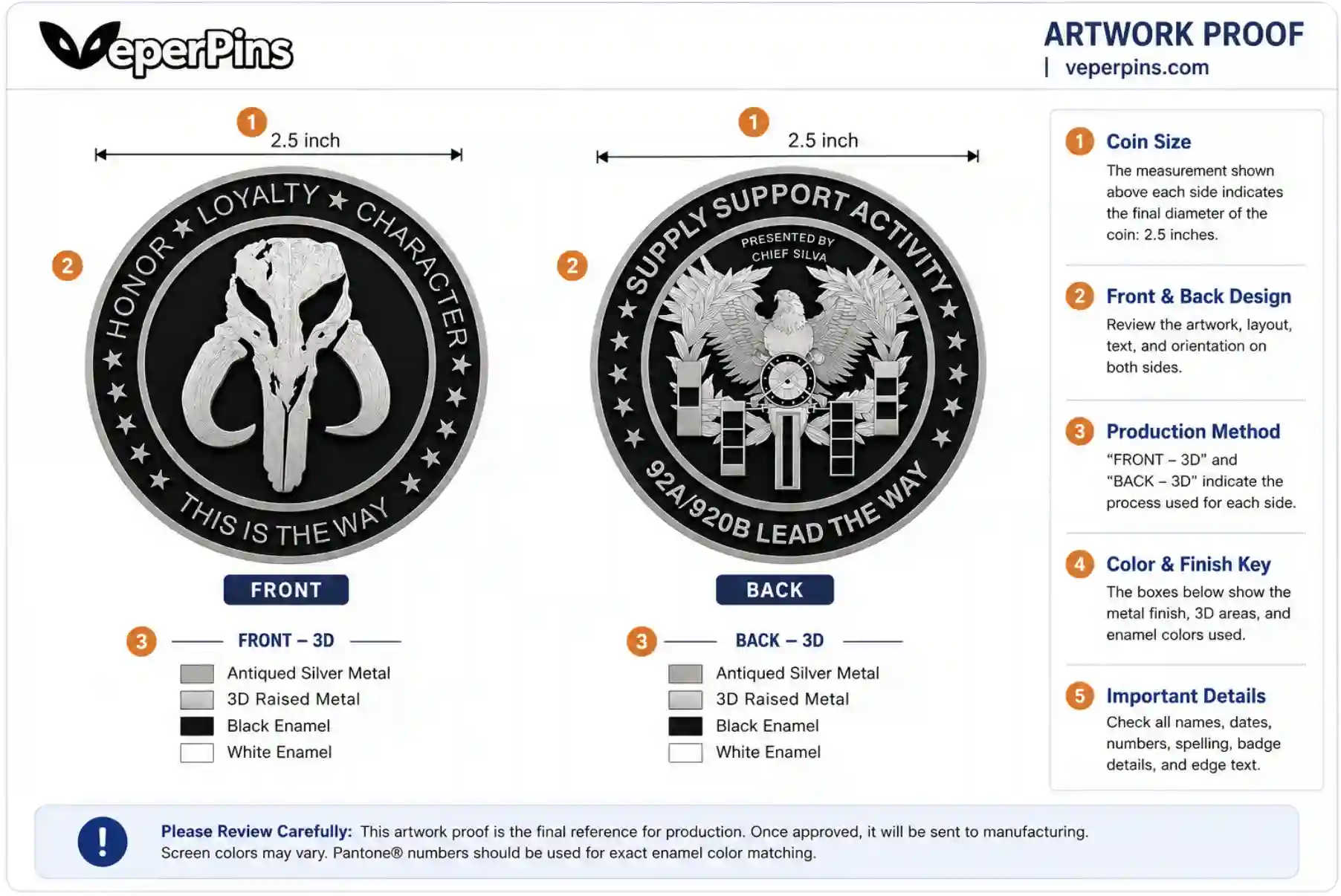
How to Review Your VeperPins Artwork Proof
Your VeperPins artwork proof shows the final size, front and back layout, production method, metal finish, and color details that will be used during manufacturing. Use the numbered labels in the example below to review each section before approving your design.
Is It Difficult to Prepare Challenge Coin Artwork?
After reading the technical requirements above, preparing artwork for a custom coin may sound complicated. There is no need to worry.
These specifications are mainly provided for experienced buyers, purchasing teams, and professional designers. If this is your first time ordering custom coins, you do not need to understand every production detail.
You can simply send us an image.
- Your logo
- A reference picture
- A hand-drawn sketch
- An AI-generated design
Once we receive your quote request, we will review the design, explain which production methods are suitable, and recommend any adjustments that may improve the finished result.
In fact, about 90% of the inquiries we receive begin with an AI-generated image or a regular reference picture. Once the artwork is prepared for production, the finished coins can still look excellent.
Send us what you have. Our team will help with the rest.