
Table of Contents
When customizing challenge coins, many customers are unsure whether their design should be made in 2D or 3D. This is especially common for first-time buyers, and it is completely normal.
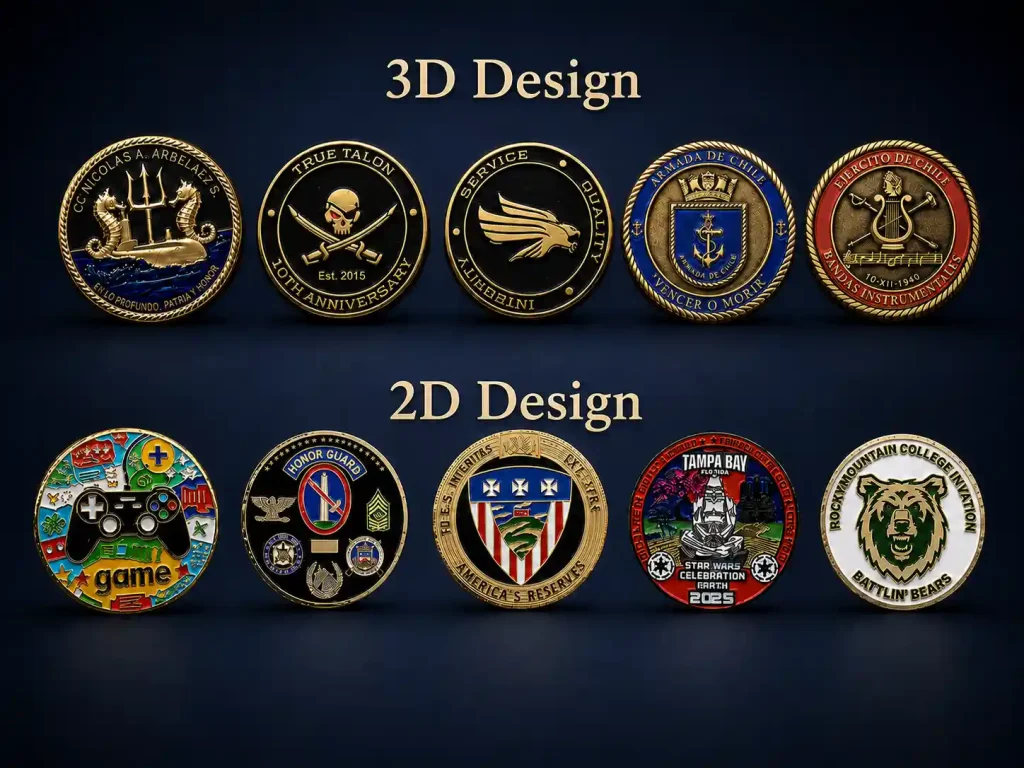
In simple terms, 2D designs are better for logos, text, line artwork, and clean color areas, while 3D designs are better for portraits, buildings, animals, shields, and artwork that needs stronger depth and sculpted details.
If you want to learn more, you can also read our Custom Challenge Coins guide for a complete overview.
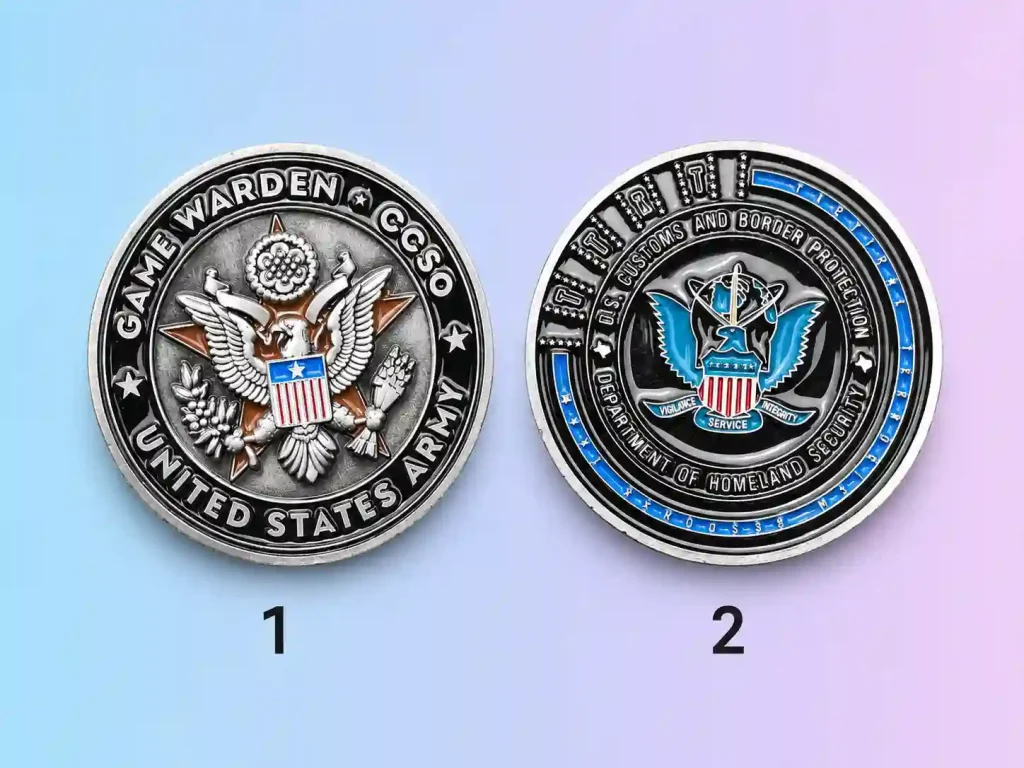
Can you tell from the image above which side is a 3D design and which side is a 2D design?
The answer is: “1” is the 3D design, and “2” is the 2D design.
If you look closely, you can see that the eagle and the upper pattern in area 1 are raised from the coin surface. This is made using a high-relief 3D design. In area 2, the eagle is recessed and filled with color, which is a typical 2D design.
Below, we will explain the differences between 2D and 3D challenge coins in detail.
What Is a 3D Challenge Coin?
A 3D challenge coin, often referred to as a high-relief design, features raised, dimensional artwork with strong visual depth. Instead of looking like a flat design on a metal surface, the artwork appears more like a small sculpted relief emerging naturally from the coin.
Compared with a standard 2D challenge coin, a 3D challenge coin does not rely only on simple raised and recessed flat areas to define the design. Instead, it uses rounded lines, gradual height transitions, curved contours, and more detailed sculpting to create a realistic three-dimensional effect. This makes it especially suitable for portraits, animals, buildings, shields, emblems, mountains, commemorative scenes, and other designs that require rich detail and depth.
When producing a 3D challenge coin, our factory usually creates a custom mold based on the approved artwork. Different heights, angles, and sculpted details are engraved into the mold. The coin is then formed through die casting, stamping, or casting, allowing the metal surface to develop a natural raised-relief effect. The finished design not only looks deeper and more dimensional, but also feels textured and raised when touched.
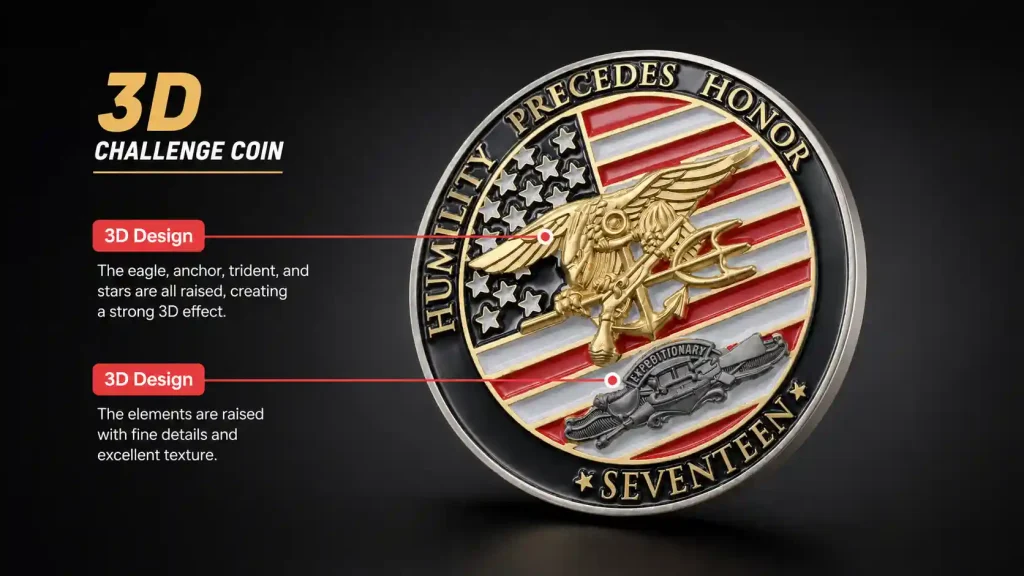
You can see that the marked elements in the image above, such as the eagle and anchor, are raised and sit higher than the edge.
What Are 2D Challenge Coins?
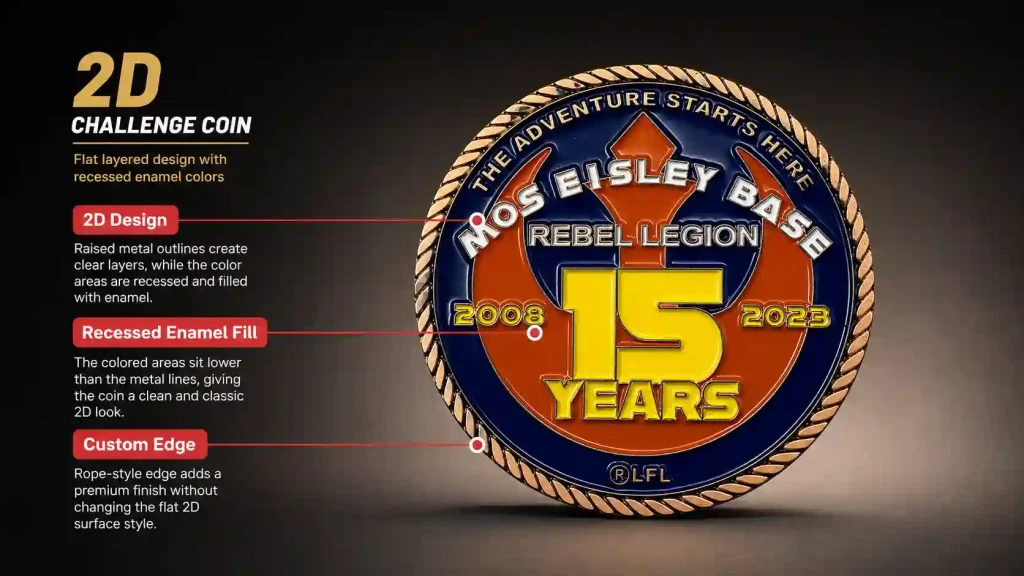
2D challenge coins are not completely flat. They have raised and recessed metal areas that create clear layers on the coin surface. When you touch the coin, you can usually feel the difference between the raised metal details and the lower background areas.
In a 2D design, the raised parts are often used for logos, text, borders, outlines, and simple graphic elements. The recessed areas can be left as metal background or filled with soft enamel colors. This clear separation between raised and recessed areas gives 2D challenge coins a clean, sharp, and easy-to-read appearance.
2D challenge coins are commonly made by stamping or die casting the design into the metal surface. This creates a design with one main raised level and one main recessed level. Because the process is reliable and widely used, 2D challenge coins are one of the most popular options for custom challenge coin projects.
They are especially suitable for logos, lettering, team emblems, badge-style artwork, and simple designs that need clear lines and strong color contrast.
Which Challenge Coin Design Is Better?
2D Challenge Coin Design Features
Small Sizes: Keeps details clear and easy to read on smaller coins.
Multiple Colors: A good choice for designs with many separate color areas.
Clear Lines: Raised metal lines make the artwork clean and organized.
Many Details: Works well for text, icons, and multiple design elements.
Lower Cost: Usually more economical than 3D coins.
3D Challenge Coin Design Features
High Relief: Great for portraits, animals, buildings, shields, and detailed scenes.
Natural Depth: Smooth curves and shadows create a sculpted look.
Main Focus: Helps the key artwork stand out.
Premium Look:
Ideal for commemorative, military, police, firefighter, and corporate coins.
Antique Finish: Antique plating makes the raised details and layers more visible.
UV Printing Option: For both raised detail and rich colors, choose 3D relief with UV printing.
Custom Challenge Coins Made for You
Whether you choose 2D or 3D challenge coins, VeperPins can customize your coins to match your artwork, purpose, and budget. With affordable pricing, fast production, and reliable quality, we help you create premium custom coins made exclusively for your brand, team, or event.
FAQ About 2D and 3D Challenge Coins
Are 2D challenge coins completely flat?
No. 2D challenge coins are not completely flat. They usually have raised metal lines and recessed areas, creating a clean layered look on the coin surface.
Are 3D challenge coins more expensive than 2D coins?
Usually, yes. 3D challenge coins often require more detailed mold engraving, so the cost is usually higher than standard 2D designs.
Can 3D challenge coins include color?
Yes. 3D coins can include color, especially with UV printing. This is a good option if you want both raised relief details and rich artwork colors.


